

For a long time, my self‑talk during anxiety sounded like a bad sports commentator.
“There he goes again, blowing it.”
“Of course you’re freaking out, you can’t handle this.”
“Nice try, but this will probably go wrong too.”
If someone else spoke to me that way, I’d cut them out of my life.
But because it was my own mind, I let it run unchecked, like a rogue spirit whispering the same tired prophecy over and over.
One day, while going through my notes, I noticed something I had been skipping.
I had pages of insights. Lists of components. Sharp observations.
But almost no counter — no grounded line I could reach for when anxiety rose like a tide.
Nothing I could actually hold in the moment.
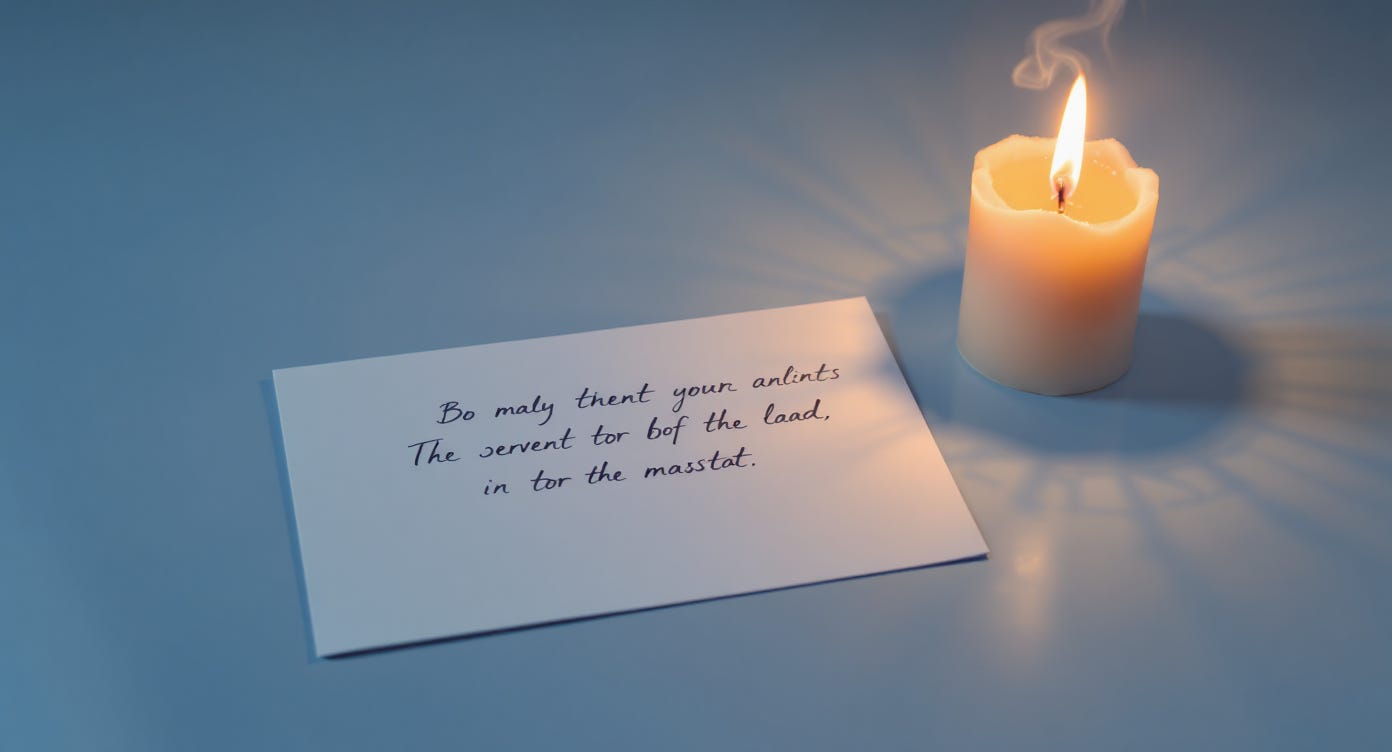
So I sat down with a single index card and wrote one line:
“I am allowed to feel anxious and still take one small step.”
That was it.
Not “I am fearless.” Not “Everything is perfect.”
Just a simple, honest incantation: I can feel this and still move a little.
To be clear, I didn’t believe it at first.
But I placed the card where I’d see it every morning, a small talisman of intention.
And every time my anxiety flared, before a call, during an email, even walking into the grocery store, I paused, looked at the line (or remembered it), and read it slowly.
Out loud when I could. In my mind, when I couldn’t.
Here’s what began to shift.
At first, the old commentary screamed over it, the familiar chorus of doubt.
But after a week or two of repeating that one sentence, something subtle appeared:
A gap.
A breath. A moment of choice.
Instead of “I’m anxious, so I must avoid this,” the chain became:
“I’m anxious… and I have that line.”
And sometimes, that was enough to take the next step instead of retreating.
The point isn’t that this exact sentence is magic.
The point is that your anxious mind already has thousands of rehearsed lines — old spells it repeats without your permission.
You need at least one line on your side. A counter‑voice. A wiser inner ally.
If you want to try this, here’s a simple way:
Think of one specific anxiety you’re working with.
Ask yourself: “What would a wise, honest friend say to me about this?”
Turn that into a short, realistic sentence. Examples:
“I can feel afraid and still stay in the room.” “This may be hard, but I don’t have to run.” “I’ve gotten through this before, and I can again.”
Write it on a card, big, clear letters.
Read it once a day when you’re calm, and again when anxiety rises.
You’re not trying to hypnotize yourself.
You’re giving your nervous system a new line of power to reach for, instead of letting anxiety speak first every time.
There’s good evidence behind this. Short, repeatable phrases can shift how strongly anxiety hooks into us. Ancient traditions knew this intuitively — they used mantras, vows, and simple spoken lines to steady the mind.
You’re doing the same thing, just in modern language.
Want More Practices Like This?
If this kind of inner exploration speaks to you — practical spirituality, ancient wisdom, and real tools for navigating anxiety — then you’ll probably love something I’ve been building quietly in the background.
It’s called The Mike Guarneri Letter.
It’s a monthly, old‑school PHYSICAL newsletter printed on high‑quality paper with a hole‑punched design.
Every issue explores ancient wisdom, forgotten practices, and modern science in a way that helps you move from the shadows into the full light of possibility.
Not quick‑fix nonsense. Not recycled Instagram advice.
Real frameworks. Timeless ideas. Unconventional approaches that actually help you see yourself differently.
For a limited time, you can try it for free.
You just cover $9.95 for materials and processing.
You’ll also get five free gifts delivered immediately.
They’re yours to keep even if you don’t continue.
(As an accountant, I appreciate a good deal.)
After the trial, it’s $48/month.
If you want a guide to a new perspective — one rooted in ancient insight and practical tools — you can start your trial here:
Disclaimer: The content of this post is not a substitute for professional medical advice. If you are suffering from severe anxiety or depression, please contact a licensed medical professional.