

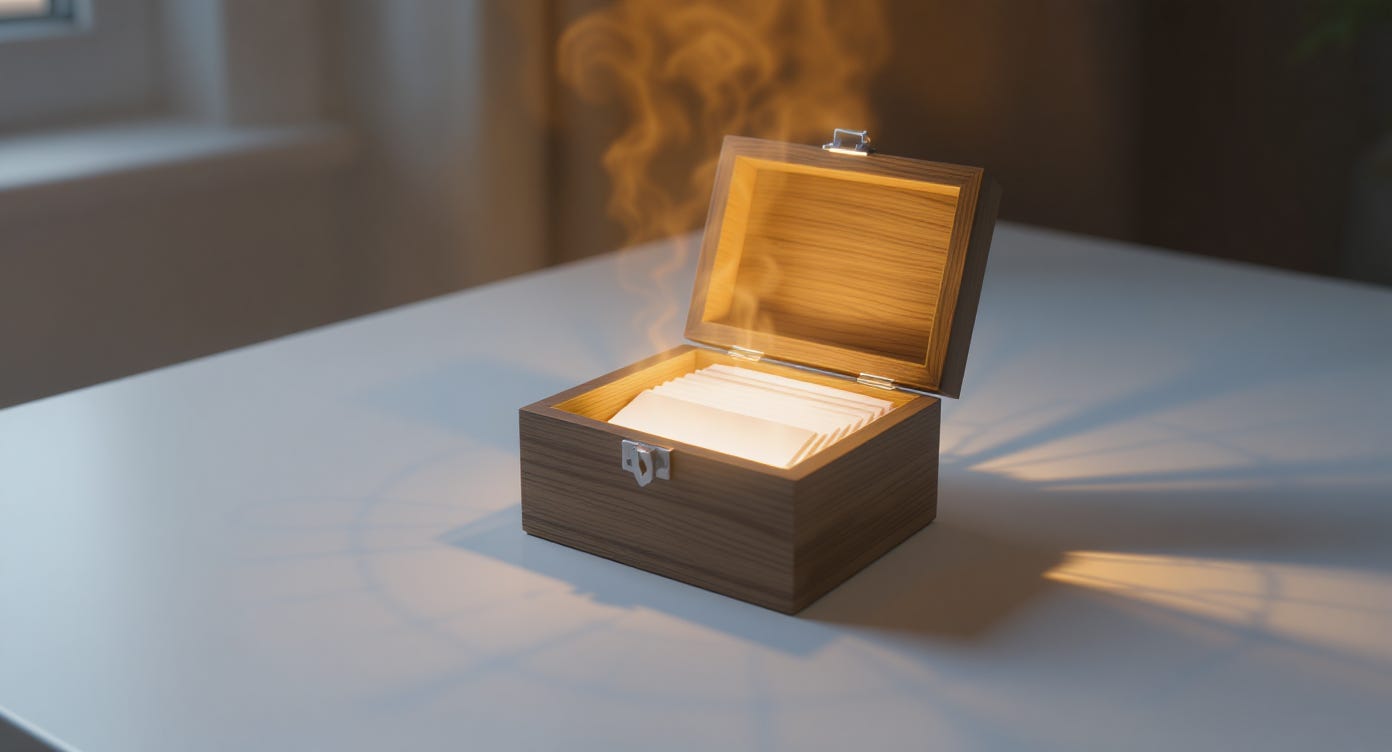
For a long time, my “system” for handling anxiety looked like this:
Think about it nonstop.
Hope for the best.
Repeat.
If you opened my mind back then, it would’ve looked like a junk drawer.
Loose fears.
Half‑formed ideas.
Nothing with a name. Nothing with a place.
Then, during a deep dive into ancient wisdom and old‑school research methods, I came across something that irritated me at first.
Index cards.
Not mystical.
Not impressive.
Just cards in a box.
But the deeper I went, the more I realized something important:
For centuries, people have used small, physical containers to hold what the mind can’t carry alone.
Monks kept commonplace books.
Scholars kept card catalogs.
Mystics kept boxes of fragments, insights, and observations, tiny pieces of the inner world made tangible.
They didn’t always trust the memory.
They trusted containers.
Meanwhile, I was trying to handle real anxiety with nothing but:
“Remember that thing you read once.”
So I gave in and tried it.
I grabbed a stack of cards and a box.
At the top of one card, I wrote the name of one specific anxiety.
Not “my life.”
Not “everything.”
One.
Then I wrote a few lines about how it actually showed up:
“When this hits…”
“What I feel in my body…”
“What I usually do next…”
It felt like I was documenting a small haunting, giving shape to something that had been drifting around unnamed.
But when I put that card in the box and closed the lid, something subtle shifted.
For the first time, that anxiety wasn’t floating in my head.
It existed somewhere.
It had a card.
It had a name.
It had a home.
Over time, I added more cards.
Not essays.
Not journals.
Just small pieces:
Things I tried.
What helped a little.
What backfired.
One‑sentence reminders I wanted future‑me to see.
The box slowly became an external brain, a physical archive of my inner work.
I didn’t have to remember every insight.
I just had to keep feeding the box.
To be clear, the box didn’t cure my anxiety.
But it did something just as important:
It gave me leverage.
Instead of feeling like I was starting from zero every time, I could flip through and see proof that I had done real work.
I had burned through fears.
Tested ideas.
Recovered from bad days.
Returned to myself again and again.
It was all there, in ink, a quiet record of transformation.
If you want a tiny taste of this, here’s a simple experiment:
Grab one card (or a small piece of paper) and a pen.
At the top, write the name of one specific anxiety:
“Sunday night work dread.”
“Driving over bridges.”
“Making phone calls.”
Under that, write three short lines:
“Shows up as: ___***”
“Feels like: ”
“Today I will try: ***___” (keep it small and realistic)
Put the card somewhere you’ll see it.
At night, add one line on the back:
“What actually happened: ______”
Then save the card.
Don’t judge it.
Don’t turn it into a life report.
Just keep it.
You’ve now taken one slice of your anxiety and given it a physical form, something
outside your head, something you can return to, something you can shape.
A small card.
A tiny ritual.
A place to put the things that used to float.
Want More Practices Like This?
If this kind of inner exploration speaks to you: practical spirituality, ancient wisdom, and real tools for navigating anxiety, then you’ll probably love something I’ve been building quietly in the background.
It’s called The Mike Guarneri Letter.
It’s a monthly, old‑school PHYSICAL newsletter printed on high‑quality paper with a hole‑punched design.
Every issue explores ancient wisdom, forgotten practices, and modern science in a way that helps you move from the shadows into the full light of possibility.
Not quick‑fix nonsense.
Not recycled Instagram advice.
Real frameworks.
Timeless ideas.
Unconventional approaches that actually help you see yourself differently.
For a limited time, you can try it for free.
You just cover $9.95 for materials and processing.
You’ll also get five free gifts delivered immediately.
They’re yours to keep even if you don’t continue.
After the trial, it’s $48/month.
If you want a guide to a new perspective — one rooted in ancient insight and practical tools — you can start your trial here:
Disclaimer: The content of this post is not a substitute for professional medical advice. If you are suffering from severe anxiety or depression, please contact a licensed medical professional.